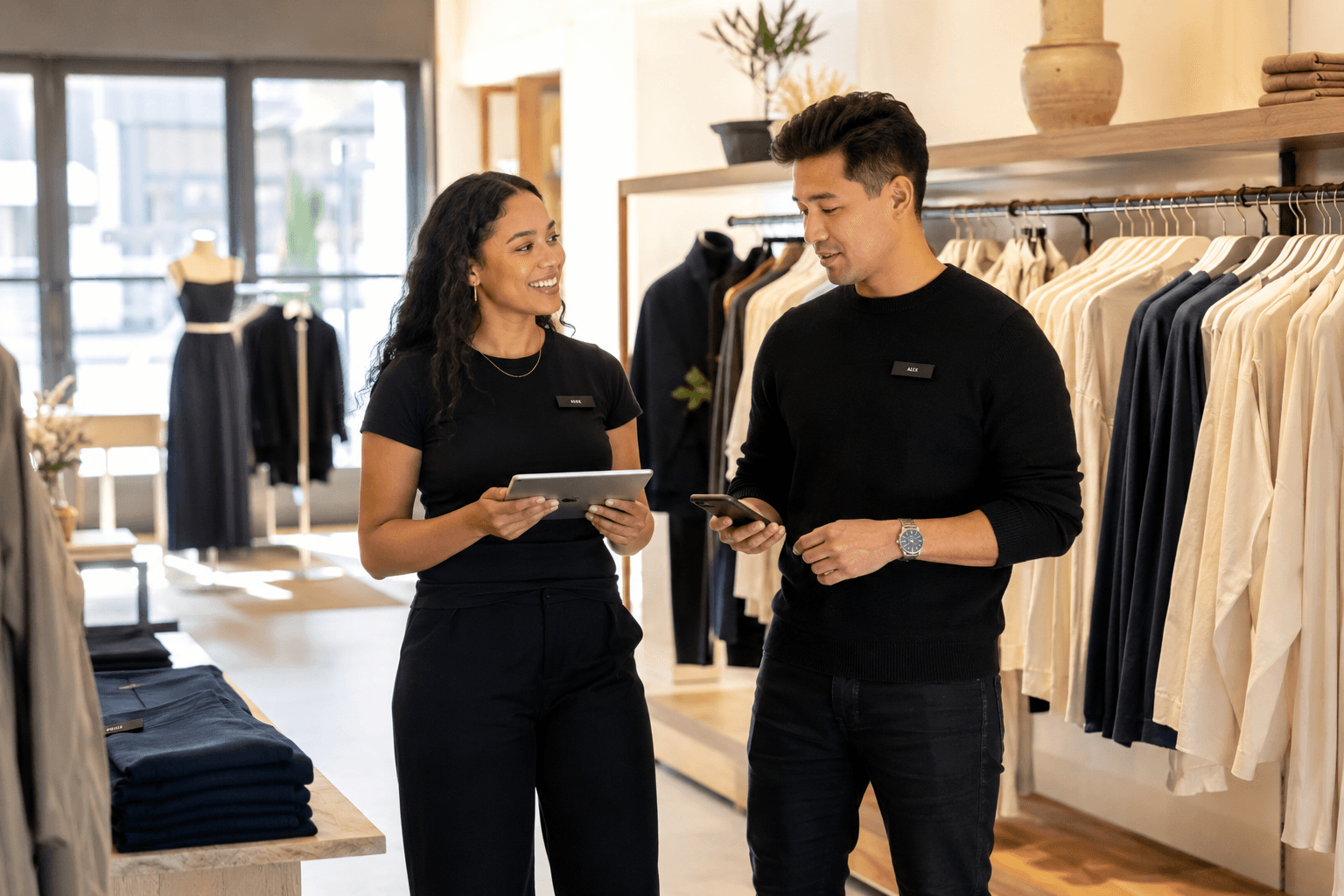
Jewelry store associate using a tablet to assist a customer.

Invisible Tech, Visible Results: A CIO’s Secret to Modernizing James Avery Jewelry

For some heritage brands, the word “automation” can sound foreign to the organization’s roots. When a company’s reputation is built on craftsmanship, loyalty, and decades of customer relationships, introducing new jewelry retail technology might feel like tampering with tradition.

At James Avery—a Texas-based jeweler with more than 70 years of history—the brand’s identity has been grounded in the craftsmanship of its pieces and the stories of the people who wear them. So, how can a brand built over seven decades thoughtfully evolve into jewelry retail digital transformation in a way that feels authentic to its legacy?

For Harsha Bellur, James Avery’s Chief Information Officer, the answer wasn’t to introduce more complex software. It was invisible technology.

Bellur focused on simplification and removing friction rather than adding complicated features for associates to learn. The result is a masterclass in scaling a vertically integrated business without losing the human touch that defines it. 

For jewelry retailers looking to thrive in 2026, Bellur’s strategy offers a blueprint for balancing tradition with modern efficiency.

How to Simplify a Jewelry Store’s Tech Stack 

“The best technologies are the ones that nobody sees or feels,” Bellur says. “It has to fit into the workflow of the people that use it on a day-to-day basis.”

This philosophy is the foundation of James Avery’s digital transformation. 

As a vertically integrated company that manages design, prototyping, manufacturing, and retail in-house, James Avery operates a complex ecosystem. In the past, an associate might have used six to eight different applications to complete a single customer request.

Bellur’s mission was clear: uncomplicate the system.

James Avery consolidated scattered systems into a single, intuitive interface. Now, instead of navigating multiple or outdated tools, associates can focus on their craft and their customers. 

Associate Experience in Retail Technology: Why It Comes First

When associate experience improves, customer experience follows. That’s particularly true in artisanal jewelry, where purchases are rarely purely transactional. Often, they mark emotional milestones—birthdays, graduations, engagements, anniversaries—and associates are the brand stewards who ensure the purchasing experience feels meaningful.

“But you can’t expect an associate to deliver an ‘A-plus’ emotional experience if they’re struggling with a “C-minus” back-end system,” Bellur explains. “Customer experience starts with associate experience.” 

At James Avery, where some customers have been shopping for 50 years, the associates sometimes act as historians. When a granddaughter brings in a single 30-year-old earring inherited from her grandmother and needs help finding its match, the associate must be able to access historical data immediately. By unifying existing customer data with the Order Management System (OMS) and Point of Sale (POS), into a unified retail platform, Bellur ensures that those priceless stories and the customer loyalty they represent are never lost.

Jewelry Engraving Automation: Modernizing the Craft 

Perhaps the clearest example of Bellur’s “business-first, tech-second” philosophy is the transformation of James Avery’s engraving process.

In the past, engraving was a manual, paper-reliant process. Customers could design online, but their vision was transmitted onto paper before reaching the manufacturing floor. This led to a slew of possible interpretation errors, slow lead times, and a reliance on highly specialized technicians to manually configure laser machines.

Bellur’s team reimagined the workflow by developing a script that feeds the customer’s digital design directly into the laser engraving machines.

The results were immediate:

  • Accuracy: The error rate dropped to near zero.
  • Speed: The process became nearly instant.
  • Labor: It eliminated the need for special skills to run the machines, allowing artisans to focus more on the jewelry than on the software.

It’s what Bellur calls a “rising tide” effect: optimize one friction point, and efficiency improves across the entire supply chain.

Scaling Change in a High-Tenure Culture: A Lesson in Retail Technology Adoption 

Change management can be one of the most difficult parts of jewelry retail digital transformation, especially in a company with long-tenured employees.

James Avery boasts an incredibly high employee tenure, with some staff working at the company for decades. Introducing a new POS system to someone who has used the same process for 20 years requires empathy.

Bellur credits James Avery’s retail operations team for championing the technology rollout. Rather than a mandated software update, the transition to a unified platform was treated as an internal campaign. Complete with internal marketing, engaging training sessions, and a focus on how the tool would make the associates’ day-to-day lives easier, adoption was collaborative across the business.

The outcome speaks for itself. James Avery maintains an extraordinary Net Promoter Score (NPS) of 93, a figure almost unheard of in traditional retail, where average scores hover around 32. 

When technology is implemented with respect for the user, it doesn’t replace the brand’s culture; it strengthens it.

The future is simpler 

Looking ahead, Bellur sees the end of “Frankenstein tech stacks”—an era of layering apps until the overloaded system weakens and falls apart.

Bellur’s near-future focus continues to be simplification. He envisions AI-driven tools, including internal chatbots that can answer associates’ policy or procedure questions instantly, further reducing the cognitive load on store staff.

As Bellur puts it, the goal isn’t to be a tech company. The goal is to be a 72-year-old artisan jeweler that’s smart enough to use retail technology solutions  to stay relevant for the next 70 years.

The Takeaway for Jewelry Brands Navigating Digital Transformation 

Harsha Bellur’s approach offers a vital lesson for legacy jewelry brands navigating modernization: technology serves the story. 

Whether it’s reducing manufacturing lead times by 50%, or moving online revenue from 15% to 40%, improved metrics are important because they protect what matters most: the emotional bond between the jeweler and the wearer.

The best technology gets out of the way and lets your brand shine. If you’re ready to modernize without losing what makes you, you — we’d love to talk.


Frequently Asked Questions

How do you introduce new technology to long-tenured retail employees?
Treat the rollout as an internal campaign, not a software mandate. James Avery’s approach used internal marketing, hands-on training, and framed the tool around making associates’ daily work easier. This achieved collaborative adoption even among staff with decades of experience on legacy systems.

How many POS systems should a retail jewelry store have?
Ideally, one. James Avery reduced its fragmented applications down to a single unified interface. The fewer systems an associate has to navigate mid-customer interaction, the better the experience on both sides of the counter.

What’s a realistic NPS score for a jewelry retailer?
The average retail NPS hovers around 32. Anything above 70 signals exceptional customer loyalty. James Avery’s score of 93 reflects years of investing in associate experience, proving that operational improvements compound directly into customer satisfaction.

Omnichannel Expectations Skyrocket: What Consumers Want from Store Associates

Each year, NewStore asks more than 1,000 consumers about the shopping experiences they expect modern store associates to provide. NewStore revisited the annual survey to better understand how consumer sentiment has shifted over time. While there are many interesting findings, which we’ll cover below, the key takeaway is this: Consumers continue to demand more from frontline retail workers.

In fact, consumer expectations for store associates’ capabilities increased in 22 of the 24 omnichannel categories we assessed year over year. For comparison, in 2023, expectations were up in 18 of 24 categories. Not only that, but expectations for each capability increased by an average of 5% across the board.

Key Findings: Major Trends and Insights

  1. Demand for clienteling and remote selling is up: 60% of consumers expect store associates to contact them about new product arrivals, promotions, and more (up from 57% in 2023 and 48% in 2021 ), while 43% of consumers expect associates to offer remote selling options (up from 35% in 2023 and 26% in 2021).
  2. Expectations for personalization increase: 50% of consumers expect store associates to be able to access their loyalty profiles and apply rewards just by knowing their names (up from 42% in 2023 and 37% in 2021), while 53% of consumers expect to be able to schedule one-on-one in-store appointments with an associate (up from 46% in 2023 and 33% in 2021). 
  3. Demand for associate mobility continues to rise: 63% of consumers expect store employees to have a mobile device (up from 59% in 2023 and 54% in 2021), and 46% of consumers expect associates to be able to check them out anywhere on the store floor with a mobile device (up from 43% in 2023 and 33% in 2021). 
  4. Endless aisle and mixed cart expectations remain high: 68% of consumers expect store associates to be able to sell products that aren’t available in the store and ship them (up from 67% in 2023 and 2021), while 63% expect associates to be able to sell products in-store along with items that are not available in-store (up from 57% in 2023 and 56% in 2021).
  5. Checkout innovations continue to see interest: 45% of consumers expect to be able to check themselves out with a mobile device without ever interacting with a store associate (up from 42% in 2023 and 39% in 2021), and 66% expect store associates to accept all forms of contactless payments like Apple Pay, Google Pay, Venmo, and others (up from 63% in 2023 and 2021).

Emerging Trends: The Rise of Remote Selling and Clienteling

While remote selling and clienteling capabilities are not the most in-demand omnichannel features, consumer interest in these types of shopping experiences is accelerating faster than any other category.

Clienteling has emerged as a particularly popular method of engagement, with today’s consumers increasingly expecting store associates to reach out via email or text about deals, discounts, new arrivals, product availability, promotions, and store events. From 2021 to 2024, demand for email clienteling has risen significantly from 48% to 60%, while text clienteling has also seen a substantial increase, from 37% to 53%.

Similarly, remote selling is experiencing a sharp increase in consumer demand. The desire for store associates to provide product information, conduct sales, and complete transactions via text has nearly doubled, rising from 22% to 42%. Demand for email interactions like this has increased similarly, from 26% in 2021 to 43% in 2024, indicating a growing consumer comfort with making purchases remotely.

Additionally, the ability to chat with store associates through popular social media platforms like Instagram, Snapchat, TikTok, and Facebook is becoming more integral to the shopping experience. In 2024, 35% of consumers expected this capability, up from 27% in 2021, underscoring the increasing role of social media in facilitating consumer-retailer interactions.

These insights underscore a clear trend: as consumer expectations for convenience and personalized service continue to evolve, retailers must enhance their omnichannel capabilities to include effective clienteling and robust remote selling options to meet these emerging demands.

Personalized Shopping: The Surge in Tailored Experiences

The demand for personalized shopping experiences and loyalty integrations has also seen significant growth over the past three years, reflecting a shift toward even more tailored and engaging retail interactions. The results of the 2024 NewStore survey underscore the rising importance consumers place on omnichannel capabilities that cater directly to their individual preferences and histories.

In 2024, half of the consumers expected store associates to be able to access their loyalty profiles and apply rewards just by knowing their names. This represents a notable rise from 42% in 2023 and 37% in 2021, highlighting an increasing preference for seamless and personalized loyalty interactions within the store environment.

Moreover, associates’ ability to retrieve complete shopping histories and preferences with just the customer’s name has climbed to 40%, up from 33% in 2023 and 26% in 2021. This trend indicates a growing desire for a highly personalized shopping experience that leverages data to make each interaction feel unique and tailored.

Additionally, the demand for pre-arranged, one-on-one shopping appointments in-store has also increased significantly. This year, 53% of consumers expected this service, up from 46% in 2023 and 33% in 2021. Virtual interactions have also gained traction, with 32% of consumers in 2024 expecting the ability to engage with store associates through video chat for personalized appointments, a rise from 24% in 2023 and 22% in 2021. This growth signifies an evolving retail landscape where digital and physical experiences converge to meet consumer needs.

A new dimension to this year’s survey is the expectation for personalized discounts based on previous purchases, with a substantial 66% of consumers valuing this proactive approach to discounting. This expectation demonstrates the potential for data-driven offers to enhance customer loyalty and satisfaction.

These insights reveal a clear trajectory toward more connected and personalized retail experiences. As consumer expectations continue to evolve, retailers must enhance their omnichannel capabilities to deliver not just products but also personalized and rewarding shopping journeys.

Mobile-Enabled Service: Keeping Pace with Consumer Expectations

This year’s findings reveal a steady climb in consumer expectations for store associates’ mobile capabilities, highlighting the importance of technology in enhancing the shopping experience.

In 2024, an increasing majority of consumers (63%) now believe store employees should be equipped with mobile devices, continuing the upward trend from 59% in 2023 and 54% in 2021. This sustained growth underscores the necessity for retailers to adapt and equip their teams with the tools needed for real-time engagement and service.

Mobile checkout capabilities have also seen progressive growth. From 2021 to 2023, the demand for mobile checkout spiked from 33% to 43%. Over the last year, this figure has edged up to 46%, indicating a solidifying expectation among consumers.

The capability that continues to be most sought after is the ability for associates to check inventory directly from a mobile device without leaving the customer’s side. A significant 71% of consumers expected this service in 2024, marking an increase from 69% in 2023 and 66% in 2021. This feature not only enhances customer satisfaction but also streamlines the shopping process, emphasizing the value of integrated omnichannel solutions.

Lastly, a notable new stat in 2024 is the expectation for a “Runner” service. 69% of consumers think a store associate should be able to request items from the stockroom with a mobile device without leaving their side. This highlights the growing importance of maintaining a seamless shopping experience without interrupting customer interactions.

These trends reveal a clear message: consumers increasingly value—and expect—seamless and efficient interactions enabled by mobile devices in their shopping experiences. As these expectations continue to grow, it becomes imperative for retailers to invest in and prioritize mobile capabilities to meet and exceed customer demands.

Enhancing Convenience: Embracing Endless Aisle and Mixed Cart Capabilities

The concept of the “Endless Aisle” and the flexibility of “Mixed Cart” transactions continue to resonate strongly with consumers, as evidenced by the increasing demand for these omnichannel features. These capabilities, which extend the range of available products beyond what is physically present in-store, reflect a growing consumer expectation for convenience and seamless shopping experiences.

Endless Aisle, or the ability of store associates to sell products not available in the physical store, has maintained a high level of consumer interest. In 2024, 68% of consumers expected this capability, a slight increase from 67% in previous years. This steady demand highlights the importance of integrating logistics and inventory systems to provide a broader range of products to customers directly from the sales floor.

Similarly, the expectation that associates can facilitate Endless Aisle purchases where the consumer can pick up the item from another location has seen a more noticeable increase. In 2024, 71% of consumers expected this capability, up from 68% in 2023 and 2021. This uptick suggests a consumer preference for flexible shopping options that allow them to access and receive products in ways that best suit their convenience.

Additionally, the demand for Mixed Cart transactions, where items available in-store and those that are not can be purchased in a single transaction, has grown significantly. In 2024, 63% of consumers expected this capability, a notable increase from 57% in 2023 and 56% in 2021. This trend underscores the need for retailers to adopt POS systems and backend technologies that can handle complex transactions smoothly and efficiently.

These trends indicate a consumer desire for more comprehensive and convenient shopping experiences. As consumer expectations evolve, retailers must adapt by equipping associates with access to real-time inventory information and the necessary tools to sell and ship those products, regardless of where they are located.

Advancing Retail Technology: Self-Checkout and Digital Payment Preferences

The evolving preferences of consumers for more self-reliant and digitally integrated shopping experiences are evident in the increasing demand for self-checkout options and advanced payment methods. These trends reflect a broader shift toward convenience and efficiency in the retail sector.

The desire for self-checkout capabilities, where consumers can complete their purchases using their mobile devices without needing to interact with a store associate, has seen a steady rise. In 2024, 45% of consumers expressed a preference for this feature, up from 42% in 2023 and 39% in 2021. This increasing demand highlights a growing consumer inclination towards autonomy and speed in their shopping journeys, suggesting that retailers should continue to enhance and streamline their mobile shopping technologies.

In terms of payment flexibility, the expectation that store associates accept all forms of contactless payment, including options like Apple Pay, Google Pay, Venmo, and PayPal, continues to grow. In 2024, 66% of consumers expected this capability, a slight increase from 63% in 2023 and 2021. This trend underscores the importance of accommodating diverse payment preferences, which not only simplifies the transaction process but also enhances the customer experience by offering more convenience and security.

Furthermore, the demand for electronic receipts—sent via email or text—is also on the rise. In 2024, 74% of consumers expected this service, up from 72% in 2023 and 69% in 2021. The increasing preference for digital receipts reflects a wider consumer demand for paperless and environmentally friendly options that also provide easier tracking and management of purchases.

These insights into consumer expectations illustrate a clear direction toward more technologically integrated and user-centric retail environments. Retailers must adapt to these evolving demands by implementing more robust digital solutions that cater to the convenience and efficiency consumers seek in their shopping experiences.

Conclusion: Meeting the Rising Expectations

This year’s survey highlights a clear and ongoing trend: consumers are increasingly demanding more from retail store associates, particularly in terms of omnichannel capabilities and personalized experiences. The rising expectations across various categories underscore the necessity for retailers to continuously adapt and enhance their service offerings.

Investing in mobile technology, enhancing personalized shopping experiences, and integrating seamless omnichannel capabilities are no longer optional but essential for meeting consumer demands. By staying ahead of these trends and understanding their customers’ evolving preferences, retailers can ensure they provide exceptional shopping experiences that drive loyalty and satisfaction.

Reach out to one of our experts if you’d like to learn more about how store associates can drive omnichannel success. 

Woman holding up two shirts in an apparel store

Survey: Consumer Expectations for Store Associates’ Omnichannel Capabilities Are on the Rise

The retail industry is still grappling with the effects of inflation and the unpredictability of consumer spending patterns. While this may bring feelings of uncertainty, one thing is clear. Brands need to adapt to these shifts and understand that expectations for store associates continue to skyrocket. In fact, consumer expectations for store associates increased in 18 of 24 omnichannel categories researched in our latest “Ideal Associate Profile” research study.

The goal of this research is to provide essential insights that enable brands to identify the experiences they should prioritize in order to deliver exceptional service, strengthen loyalty, and increase sales. Furthermore, the survey investigates the impact of the current economic situation on consumers’ inclination to shop both in-store and online.

We analyzed responses from over 1,000 shoppers and compared the results to our previous survey conducted in 2021, revealing the findings outlined below.

Key Findings: Major Trends and Insights

  1. Economic shifts impact consumer spending: The current state of the economy is impacting consumers’ willingness to shop in-store (43%) and online (45%).
  2. Associate mobility is on the rise: 60% of consumers expect store employees to have a mobile device (4% increase), and 44% expect to check out anywhere on the store floor (11% increase).
  3. Demand for clienteling and remote selling is up: 49% of consumers expect to text with associates to learn about products (12% increase), and 34% expect associates to sell them items remotely via text (13% increase).
  4. Consumers want flexible return options: ​​53% of consumers expect associates to accept returns for items bought at other stores (9% increase), and 62% expect to be able to buy online/ return in-store (11% increase).
  5. Interest in one-on-one shopping appointments grows: Expectations for in-store (46%) and virtual appointments (25%) have increased by 13% and 3%, respectively. 
  6. Expectations for customer convenience increase: 42% of consumers expect associates to access their loyalty profiles and apply rewards with only their name (5% increase).
  7. Checkout innovations continue to see interest: 72% of consumers expect store associates to send them a receipt via text or email (3% increase).
  8. Endless aisle expectations remain high: Consumers expect store associates to be able to find out-of-stock items elsewhere and ship them (66%) or pick up the order at another store (68%). 

Read on to learn more about the findings and consumers’ expectations for modern store associates.

The Economic Environment: Impact on Consumer Shopping Behaviors

While a significant number of consumers (39%) have confirmed they are shopping at brick-and-mortar stores more often than a year ago, the survey revealed that the current economic environment is impacting their willingness to spend in-store (43%) and online (45%). 

As a result, discounts, promotions, and sales have become more important for both shopping channels – 77% of consumers said they are more important when shopping in-store, and 79% said they are more important when shopping online. 

Furthermore, 60% of consumers expect associates to offer deals and help them find discounts when shopping in physical stores. This emphasizes the need for store employees to know about promotions and pricing to meet consumer expectations and provide valuable assistance during challenging economic times.

Associate Mobility: Meeting Consumer Expectations

In recent years, store associates have seen a shift in their roles as consumers increasingly expect them to use mobile devices to provide a seamless shopping experience. The survey results show that 59% of consumers believe store employees should be equipped with mobile devices, a slight increase from 54% in 2021. This trend indicates a growing demand for associate mobility, which enables store teams to provide real-time information and assistance to customers.

Mobile checkout is another area experiencing growth. In 2021, one-third of consumers agreed or strongly agreed that store associates should be able to check them out anywhere in the store using a mobile device. However, the updated survey shows that this number has risen to 44%, demonstrating a significant increase in consumer demand for mobile checkout capabilities.

Additionally, 69% of consumers expect associates to be able to check store inventory without leaving their side. Even though this is only a modest 3% increase from 2021, this highlights the importance of equipping associates with the tools and technology necessary to provide real-time inventory information on the sales floor.

Remote Selling and Clienteling: Expanding Beyond the Store Floor

Alternative shopping experiences that extend beyond the physical store are also becoming increasingly popular among consumers. According to the updated survey, customers are more open to communicating with store associates and purchasing products remotely than before. 

Approximately half of all consumers now expect store associates to text or email them about deals, discounts, new arrivals, product availability, promotions, and store events (we define this type of interaction as clienteling). Expectations for text clienteling have risen by 12% since 2021, while expectations for email clienteling have increased by 9% over the same period. 

While remote selling is also gaining traction, it remains less mainstream than clienteling. Over one-third of consumers expect associates to share product information, sell, and check them out via text message or email, representing a 13% and 9% increase for each communication channel, respectively. The most logical reason for this increase is that consumers got used to interacting with store associates remotely during the pandemic, and these behaviors and preferences are continuing to stick.

Additionally, more than half of consumers still expect to chat directly with store associates via a brand’s website (55%) and mobile app (56%) — both data points remained relatively stable year-over-year. However, only 25% of consumers expect store associates to manage their brand’s direct messages on popular social media apps like Instagram, Snapchat, TikTok, and Facebook, with a 2% drop from 2021 to 2023. 

Even though social commerce sales are on the rise, and brands should take advantage of this channel, store associates should not be expected to manage these interactions.  

Flexible Return Policies: Improving Consumer Convenience

Even as some brands have tightened their policies by charging for online returns, shoppers are demanding more flexibility when making returns — and they don’t want to bring a receipt. 

Expectations for buy online return in-store (BORIS) without a receipt have increased from 51% in 2021 to 62% in 2023. In addition, over half of consumers (53%) now expect associates to accept returns (without a receipt) for items bought at other stores, a 10% increase from 2021. These findings suggest that brands should consider offering more flexible return policies to meet the evolving demands of their customers.

Personalized Shopping Appointments: Catering to the Modern Shopper

The demand for personalized, one-on-one shopping appointments is on the rise. In 2021, approximately one-third of consumers expected associates to meet with them in-store for individualized shopping experiences. However, this figure has increased to 46% in the updated survey, suggesting a growing interest in planned shopping appointments.

While demand for virtual shopping appointments remains relatively low at 25%, this marks a 3% increase from 2021, indicating a gradual shift in consumer expectations. Brands should consider offering both in-person and virtual shopping appointments to accommodate the diverse preferences of their customer base.

Personalized Services and Technology: Enhancing the Customer Experience

A significant percentage of consumers want personalized services without giving up a lot of information during the transaction. The survey found that 42% of consumers expect associates to access their loyalty profiles and apply rewards with only their name, a 5% increase from 2021. Additionally, 33% of consumers expect associates to find their shopping history, sizes, and other preferences with just their name, a 7% increase from the previous year. 

On a related note, electronic receipts are also becoming more popular, with 72% of consumers expecting store associates to send them a receipt via text or email, reflecting a 3% increase since 2021. To meet these expectations, brands must manage customer data safely and securely on the backend and make that information readily available for store associates.

Mobile self-checkout is growing in popularity but has yet to become mainstream, with 42% of consumers expecting to shop in-store and check themselves out using a smartphone without interacting with a store associate (a 3% increase from 2021). Given the fact that self-checkout is catching on in the grocery and quick-service retail industries, traditional apparel, footwear, and accessories brands should explore how they can integrate this experience into their stores before it becomes a must-have capability. 

Lastly, most consumers (64%) expect associates to accept contactless payment methods like Apple Pay, Google Pay, Venmo, and PayPal, a 1% increase from 2021. According to the global edition of the 2023 Omnichannel Leadership Report (a separate research initiative that we produce), contactless payments have already become table stakes in other regions like Europe and Australia, where brand adoption is at 96%. Adoption in North America is only at 76%, so retailers in the U.S. should take notice as consumer expectations for fast, simple, and secure payment options will only increase. 

Endless Aisle: Maintaining Popularity Amidst Changing Expectations

Despite the relative stability of consumer expectations for endless aisle capabilities, the majority of consumers still expect associates to be able to sell products not available in-store. According to the survey, 66% of consumers expect store associates to find out-of-stock items elsewhere and ship them to their desired location. In comparison, 68% expect associates to sell them items that are available in other stores and allow them to be picked up later that day. These figures remain consistent with the 2021 data, showing demand is still high for these transactions. 

Moreover, when purchasing products in-store along with items unavailable in-store (what we call a mixed cart transaction), 57% of consumers expect associates to complete the transaction in a single, streamlined process, reflecting a 1% increase since 2021. All of these points highlight the importance of integrating endless aisle options into store operations to provide a seamless shopping experience for customers.

Store Associates Are a Key Piece of the Omnichannel Puzzle 

The results of this latest consumer survey confirm that to remain competitive in the current retail environment, brands must prioritize exceptional service and omnichannel experiences that cater to the diverse needs of their customers. By embracing technology and innovation, store associates can play a vital role in delivering shopping experiences that drive customer loyalty and boost sales.

Reach out to one of our experts if you’d like to learn more about how store associates can drive omnichannel success. 

woman shopping in a retail store

Upselling and Cross-Selling: Boost Sales with an Omnichannel Approach

Your customer is just about to make a purchase, whether that means tapping their card at the point of sale or clicking the “buy” button on your website. 

While that will of course be a positive for your sales that day, it’s also the moment you could be losing money. The time between when the customer decides to make a purchase and when they actually buy is an opportunity to upsell and/or cross-sell.

Below we discuss upselling and cross-selling, two classic retail sales techniques, and how several omnichannel solutions can help you generate even more revenue. 

What Is Upselling?

Upselling is suggesting or giving a customer a reason to select a more expensive (or higher margin) item than the one they originally intended to buy. For example, a store associate informs the buyer of a computer with 4GB RAM that an 8GB model might be a better choice if they like streaming. It implies that the merchant knows their line of products and is recommending a comparable one that may better fit the customer’s needs. 

What is Cross-Selling?

Cross-selling is the skill of proposing a complementary product from a different category for the customer to buy, often with a small discount attached or a reason why it’s time to buy this now. Whether that’s from an experienced sales associate in-store or an algorithm for an online transaction, the idea is the same: “Since you’re buying Product X, we recommend Product Y.” Some brands, like Outdoor Voices, have permanent cross-selling offers. At OV, if you buy a kit (a top + a bottom), you’ll get a free gift.

What Is the Difference Between Upselling and Cross-Selling?

Upselling is the practice of suggesting an alternate product that both gives the consumer satisfaction and the brand a higher profit margin, while cross-selling is showing the customer a related or complementary product they may not have previously considered. 

When they’re successful, whether used together or separately, both can help increase average order value (AOV). That’s an important metric to consider, as is the buying experience which will drive up customer lifetime value.

4 Omnichannel Tools That Support Upselling and Cross-Selling

You’re likely familiar with omnichannel retail, which unifies digital and physical retail and creates a seamless customer experience (CX). However, you may not be aware of how to leverage an omnichannel approach to enhance your sales program. 

Below are omnichannel solutions that can drive your ability to upsell and cross-sell.

1. Mobile Point of Sale (mPOS)

A mobile point-of-sale (mPOS) system provides opportunities for upselling and cross selling by making it easy to offer retail clienteling, the customer-centric service approach that allows for the creation of more personalized relationships.

With an omnichannel mPOS, store associates can see the customer’s purchase history across all channels, giving them a holistic view of the shopper so that they can make targeted upsell and cross-sell recommendations. 

For example, while helping a sporting goods customer buy a tent, the associate can see they purchased new sleeping bags last month so that suggestion is unlikely to be successful. However, perhaps they would be interested in a propane stove for their next camping trip. 

In addition, although upselling and cross-selling typically occur at the moment of purchase, a mPOS allows store associates to communicate with the consumer after the sale through an app, SMS, or email. This gives the associate more opportunities to suggest additional purchases to customers.

2. Shopping App

Investing in a shopping app can be a big boost for your business. An app enhances the customer journey significantly, allowing you to form deep connections with customers and drive loyalty.

With a shopping app, you have the ability to send push notifications that notify customers about new products, offers, and even product availability in real-time as they browse in-store. You can also send personalized messages to customers about their loyalty points, order status, vouchers, and rewards.

Consider a shopper who walks into one of his favorite shoe stores. The brand’s app knows his purchase history and that he buys running shoes every six months. The app can then send him a personalized message about a new model and offer a discount if he buys the shoes and a pair of performance socks today.

3. Order Management System (OMS)

A modern order management system (OMS) can support your ability to upsell and cross-sell since it supports store fullfillment services that connect customers with products.

There will also be those unfortunate times when a customer needs to return a product. It’s possible, however, to turn a return into a sale. With buy online return in-store (BORIS), you have an opportunity to get customers into your store. Now you can learn more about their needs and what products may be a better fit. The customer may return the ill fitting pair of work pants, but now you’re able to upsell them a sleek pants suit.

With buy online pickup in-store (BOPIS), you have the ability to cross-sell. A customer can come in to pick up the pair of pants they purchased online, and then be convinced by an associate to purchase the matching shirt. 

4. Inventory Management

Having precise inventory gives your upselling and cross-selling program the power it needs to work. 

Real-time inventory visibility allows you to easily track products and sell across channels. And with endless aisle the phrase, “We can’t get you that product,” has effectively been eliminated from store associates’ vocabulary. 

Endless aisle allows you to order out of stock or unavailable items for in-store customers. So, if you present the perfect complementary pair of shoes to the dress your customer is about to purchase, but they are not available in store, the customer can still walk out having purchased the shoes too.

Unlock Opportunity with Omnichannel 

Leveraging omnichannel tools that allow you to deliver a highly personalized customer experience will greatly help support your upselling and cross-selling programs. 

If you’re ready to grow your sales, reach out today to learn about how NewStore’s solutions can help your store associates better upsell and cross-sell.

store associate folding clothes

Advantages of a Mobile Point of Sale (mPOS) for Store Associates

The role of a store associate has evolved greatly in recent years. Gone are the days of disappearing into the back room to look for a customer’s size and ringing up items behind a counter.

Retail technology has made the store associate role far more dynamic. In particular, mobile point of sale (mPOS) devices help reduce operational pain points and make it easier to connect with customers.

Below, we discuss the benefits of mobile point of sale devices and how this technology enhances the role of the store associate, creating a far better experience for both employees and customers.

Omnichannel Store Associates

Less forward-thinking retail brands have permitted competition between their online and physical storefronts. This is a short-sighted and self-defeating business model. 

Adopting an omnichannel approach–one that seamlessly integrates the online and physical experience–is critical for retail brands that want to succeed in today’s digitally connected world. 

Customers shopping across various channels is a good thing. Not only for your bottom line but also for store associates who now have more opportunities than ever before to connect with shoppers and provide assistance.

Tapping into technology, such as mobile point of sale (mPOS) devices, is crucial for providing omnichannel store associates with the tools they need to reach customers across channels.

How Store Associates Benefit from Mobile Point of Sale Devices

There are many advantages of equipping store associates with mobile point of sale devices. They greatly improve their ability to create more positive interactions with customers and take clienteling to a new level.

A modern store associate can use an mPOS to:

  • Check real-time stock availability. With real-time inventory visibility across locations on a mobile device, store associates can check what’s in stock without having to leave a customer’s side.
  • Have visibility into a customer’s purchase history across channels. A complete view of the customer profile will give store associates more data to personalize interactions and be able to effectively cross-sell or upsell.
  • Create a digital “black book.” With an mPOS device, store associates can take notes and keep track of customer birthdays and preferences to build hyper-personalized relationships.
  • Accept returns for orders placed through any channel. Returns are seamless with an mPOS. Store associates don’t even need to ask customers for a receipt.
  • Provide a seamless checkout experience. An mPOS allows store associates to check out customers from anywhere in the store. Customers can use various payment methods, including tap to pay from phones, watches, and more.
  • Complete store and endless aisle purchase in a single transaction. With access to enterprise-wide inventory, store associates never have to tell customers “no.” In-store, they can combine an endless aisle order for out of stock items with items being purchased on the spot in one seamless transaction.
  • Conduct remote selling. Store associates can communicate with customers through a consumer app or text messaging to inform them about new products, respond to questions, and even build a cart.
  • Provide assistance to online shoppers. It’s possible to virtually assist customers with style and fit recommendations, send photos of products in-store, set in-store appointments, and more with an mPOS that’s synced to your online chat solution.
  • Collaborate with teammates. Store associates can share their inbox and carts with other team members to work together to take care of customers. 
  • Recognize if a customer is about to achieve a loyalty milestone. With an mPOS, store associates can help create loyal customers by letting them know about potential rewards or incentives.

Engaged Store Associates Create Loyal Customers

Store associates are vital to the modern customer experience. Armed with technology, they can spend more time doing what likely drew them to the role in the first place — helping shoppers find products they love. Making the role more enjoyable for store associates means more engaged workers and less employee turnover.

Retaining knowledgeable store associates is critical for delivering great service. Customers want to form deep relationships with their favorite brands, including with the people representing it. Customers want to see a friendly face when they walk back into your store, and they are much more likely to engage with a text message about a new collection from someone they know. Plus, if a close relationship exists, store associates can create hyper-personalized messages to customers. 

As retail brands move away from the hard-sell approach, providing highly personalized assistance is key to winning the hearts and minds of consumers. A positive store associate interaction will hold more weight with customers than any ad campaign. Also, a customer who has an overwhelmingly positive experience with a brand will often leave behind an equally content store associate. This makes the employee’s experience with your brand more meaningful and enjoyable, which again, increases the likelihood they’ll stick around for a while.

Set Your Store Associates Up for Success

A modern store associate moves between the physical store and digital world as omnichannel retail demands. The role extends beyond customer service and into delivering an experience—confidently advising and subtly upselling, while building brand trust and loyalty.

Equipping store associates with an mPOS is advantageous. It doesn’t just improve the customer experience—it improves their own job satisfaction. It’s a win all around.

To learn more about empowering store associates with technology, check out our mobile POS solution.

close up shot of hands holding phone

Why BYOD Is The Next Frontier in Retail

Bring your own device (BYOD) – specifically smartphones – emerged as a workplace trend around 2013 when enterprise employee demographics began skewing millennial. While there were naysayers and champions for BYOD programs, many businesses went forward with a roll-out because of the benefits: flexible working, better work/life balance, and greater productivity.

Retail is one industry that didn’t immediately adopt the trend. Brands were committed to their tried and true systems in stores – cash registers, desktop computers, scanners…you name it. But things have changed. Mobile devices are breaking down the four walls of retail from every angle.

A new report from BRP found 63 percent of consumers rely on mobile phones while shopping in-store to compare prices, search for offers and coupons, and check inventory, among other things. If they can’t access or retrieve what they need online, they’ll go to a store associate. In fact, 83 percent of shoppers expect retailers to provide store associates with devices so they can quickly look up information.

In-Store Mobility

So, what are the options for bringing devices to the store floor? There are a few strategies retailers can take.

  1. System Swap: Company-provided devices to replace the number of point of sale systems i.e. two devices if there were two computers.
  2. Shared Devices: Company-provided devices assigned to all store associates while on duty, which they would return at the end of a shift.
  3. Unique Personal Devices: Company-provided devices that store associates would bring home and care for (similar to a company laptop).
  4. BYOD: Unique devices owned by the store associate, with a personal data plan.  

There is value in introducing any number of devices to the in-store experience. First, having a mobile device enables store associates to be alongside customers and not tethered to a cash wrap. Because they’re small enough for employees to carry around with them, it opens up the opportunity for more meaningful associate-customer interaction.

Even more, according to Frost & Sullivan “using portable devices for work tasks saves employees 58 minutes per day while increasing productivity by 34 percent.”

Additionally, there is the opportunity to include LTE backup on devices, in case of Wi-Fi or connectivity issues. As few as one device can keep a store up and running in a bad situation, ensuring customers don’t leave empty-handed or unhapp

Reaching the BYOD Tipping Point

The above strategies are all progressive and in the name of service, so you may ask why is a BYOD strategy in retail important? While there are definitely considerations as it relates to security and use, the perceived benefits of BYOD can help store teams deliver the seamless shopping experiences consumers expect. Specific associate benefits include: 

  • Productivity: A Dell study found 61 percent of Gen Y and 50 percent of 30+ workers believe the tech tools they use in their personal lives are more effective and productive than those used in their work life. To start, there is no learning curve with a BYOD device. It’s a device your associate knows and loves, so they will not need extensive onboarding or training to perform at peak levels.
  • Motivation: If you’re looking for strong talent in a competitive market, having a BYOD policy might be exactly what you need to draw prospective employees in the door. People today are attached to their phones, and take pride in the device in their hand. When you welcome personal devices in the brand experience, you demonstrate trust – which can motivate store associates to take an active role in the success of your store.
  • Speed: When your store associates have mobile devices, they instantly become a point of sale and living website. They can help any customer with any need, from anywhere in the store. Customers don’t have to wait in line to check out, and store associates don’t have to wait for other devices to free up to be of service. It’s the convenience and efficiency of online shopping but in the physical world.

Another advantage of BYOD (not related to the customer experience) is care. The industry shows lower theft and breakage rates with personal devices. And, more overall attention and care is given to a personal device than a shared one because of the greater sense of ownership.

The Uberization of the Store Associate

The BYOD market is on course to hit $367 billion by 2022, up from just $30 billion in 2014. Its popularity and adoption continue to surge as mobile becomes the center of work and play – shopping included. Mobile is critical to the future of retail. Consumers expect access to real-time information and demand a high level of brand support.

It’s like Uber – drivers need their own smartphones to do their job, and so do retail store associates.

las vegas strip at night

3 Key Takeaways from Shoptalk 2019

More than 8,000 retail industry professionals descended upon Las Vegas earlier this month for the annual Shoptalk conference. It’s an event we’re always excited to attend, as it brings together some of the best and brightest in retail, commerce and technology.

NewStore exhibited alongside other innovative tech companies, and members of the team spent time taking in the various content tracks. Here are a few topics that stood out to us, and we encourage you to keep a pulse on.

  1.  Data Is A Tool, Not a Solution

The retail industry has been talking about data for many years now. There were several sessions dedicated to it at Shoptalk, and it came up in conversations about nearly every topic: content, marketing, privacy…you name it.

Simply having data is not the end game, though. “Getting to act on it is the most important piece” of the puzzle, proclaimed Sarah Engel, VP, Marketing & Creative Communications at Lilly Pulitzer in one talk. Greg Fancher, SVP & Chief Information Officer of Express, echoed the sentiment in another.

Retail has long had an abundance of sales data, yes. But omnichannel retailing has unlocked entirely new datasets that the whole organization can put to work. This is critical, according to Engel. She urged companies to “democratize data, not weaponize it.” GUESS?, Inc. formed an Innovation arm with a similar point of view in mind, with folks from retail operations, digital, etc. now sitting around the same table. It’s a “power team” that understands both the science and commercialization of data.

Today, there is data that can influence and measure the entire customer journey. It can inform product design and development, marketing and merchandising, customer experience and more – and deliver real business impact.

The resounding message coming out of Shoptalk, and one of the key things to remember about data, is that it is a tool – not a solution.

Photo Courtesy of Shoptalk

  1. Service is King

More and more brands are trumpeting their desire to be known for service – the specific services they provide and how they contribute to the overall customer experience.

Take Crate and Barrel for example. Neela Montgomery, CEO, spoke on stage about the brand’s mission to blend digital solutions with personalized services. Customers can work one-on-one with staff members in-store or online for design guidance. With the Crate Design Studio 3D Room Designer, powered by Modsy, shoppers have the ability to see products in their own homes before they buy. According to Montgomery, customers spend on average $1,000.00 more when they utilize Crate and Barrel’s premium design services.

The services don’t stop there. Crate and Barrel will continue to push the boundaries around events and services, with a restaurant concept coming soon. It’s a way to celebrate food and entertaining (a core product category) while giving customers another way to engage with the brand.

During a separate panel, Karin Tracy, Head of Industry, Retail/Fashion/Luxury at Facebook said: “Services need to offer utility, experience or both.” And she’s right.

The service you deliver and the services you offer should bring real value to consumers. It’s not only about them walking away with your product, though; you need to show that you exist to serve them as an individual. 

Photo Courtesy of Shoptalk 

  1. Unleashing the Store Associate

What’s always on the mind of Lowe’s CMO, Jocelyn Wong? How to activate the brand’s 300,000 store associates. In her words, they are “arguably the best marketing tool” and the greatest brand asset.

In the quest to reimagine retail stores, we can’t forget about store associates. It is as important to put them at the core of your brand strategy as it is the customer. After all, they are the ones responsible for laying the foundation for long-term, profitable customer relationships. But how do they do it? Of course, with data and through service.

With data at their fingertips – from shopper history to real-time inventory – store associates can efficiently and effectively sell product and deliver a seamless customer experience, every time. In short, productive associates create profitable brands.

If you didn’t make it to Shoptalk this year and are interested in learning more about NewStore or our show takeaways, please reach out! We’d love to chat.