Omnichannel Expectations Skyrocket: What Consumers Want from Store Associates
Last updated on July 25th, 2024 at 07:12 am
Each year, NewStore asks more than 1,000 consumers about the shopping experiences they expect modern store associates to provide. NewStore revisited the annual survey to better understand how consumer sentiment has shifted over time. While there are many interesting findings, which we’ll cover below, the key takeaway is this: Consumers continue to demand more from frontline retail workers.
In fact, consumer expectations for store associates’ capabilities increased in 22 of the 24 omnichannel categories we assessed year over year. For comparison, in 2023, expectations were up in 18 of 24 categories. Not only that, but expectations for each capability increased by an average of 5% across the board.
Key Findings: Major Trends and Insights
- Demand for clienteling and remote selling is up: 60% of consumers expect store associates to contact them about new product arrivals, promotions, and more (up from 57% in 2023 and 48% in 2021 ), while 43% of consumers expect associates to offer remote selling options (up from 35% in 2023 and 26% in 2021).
- Expectations for personalization increase: 50% of consumers expect store associates to be able to access their loyalty profiles and apply rewards just by knowing their names (up from 42% in 2023 and 37% in 2021), while 53% of consumers expect to be able to schedule one-on-one in-store appointments with an associate (up from 46% in 2023 and 33% in 2021).
- Demand for associate mobility continues to rise: 63% of consumers expect store employees to have a mobile device (up from 59% in 2023 and 54% in 2021), and 46% of consumers expect associates to be able to check them out anywhere on the store floor with a mobile device (up from 43% in 2023 and 33% in 2021).
- Endless aisle and mixed cart expectations remain high: 68% of consumers expect store associates to be able to sell products that aren’t available in the store and ship them (up from 67% in 2023 and 2021), while 63% expect associates to be able to sell products in-store along with items that are not available in-store (up from 57% in 2023 and 56% in 2021).
- Checkout innovations continue to see interest: 45% of consumers expect to be able to check themselves out with a mobile device without ever interacting with a store associate (up from 42% in 2023 and 39% in 2021), and 66% expect store associates to accept all forms of contactless payments like Apple Pay, Google Pay, Venmo, and others (up from 63% in 2023 and 2021).
Emerging Trends: The Rise of Remote Selling and Clienteling
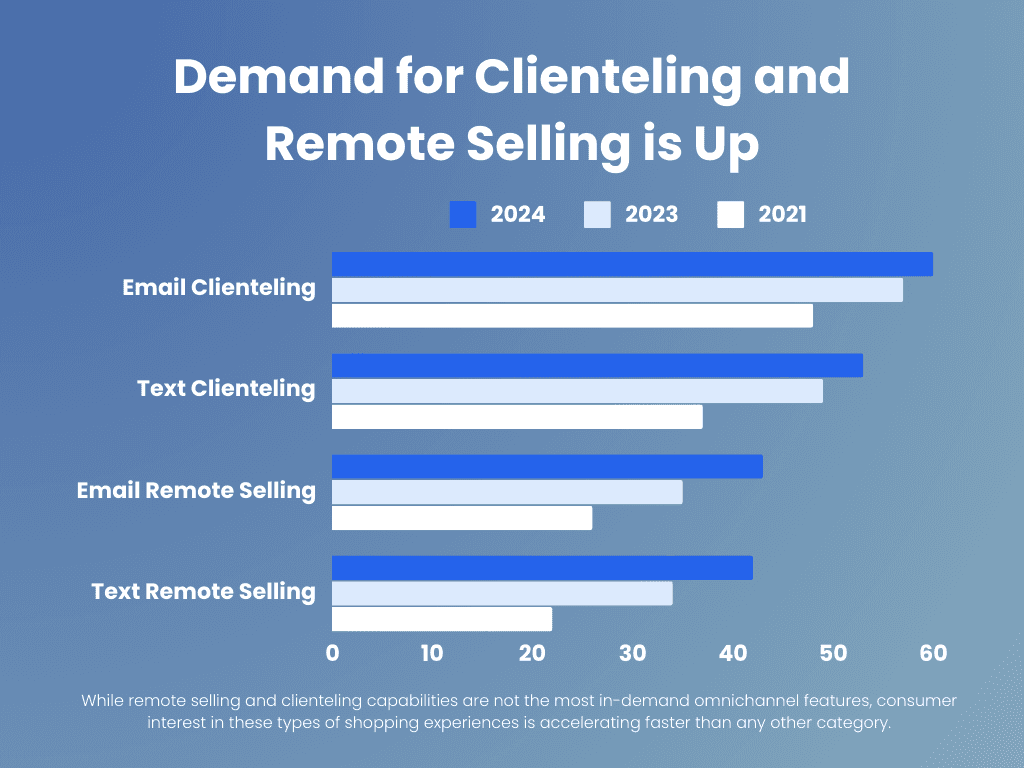
While remote selling and clienteling capabilities are not the most in-demand omnichannel features, consumer interest in these types of shopping experiences is accelerating faster than any other category.
Clienteling has emerged as a particularly popular method of engagement, with today’s consumers increasingly expecting store associates to reach out via email or text about deals, discounts, new arrivals, product availability, promotions, and store events. From 2021 to 2024, demand for email clienteling has risen significantly from 48% to 60%, while text clienteling has also seen a substantial increase, from 37% to 53%.
Similarly, remote selling is experiencing a sharp increase in consumer demand. The desire for store associates to provide product information, conduct sales, and complete transactions via text has nearly doubled, rising from 22% to 42%. Demand for email interactions like this has increased similarly, from 26% in 2021 to 43% in 2024, indicating a growing consumer comfort with making purchases remotely.
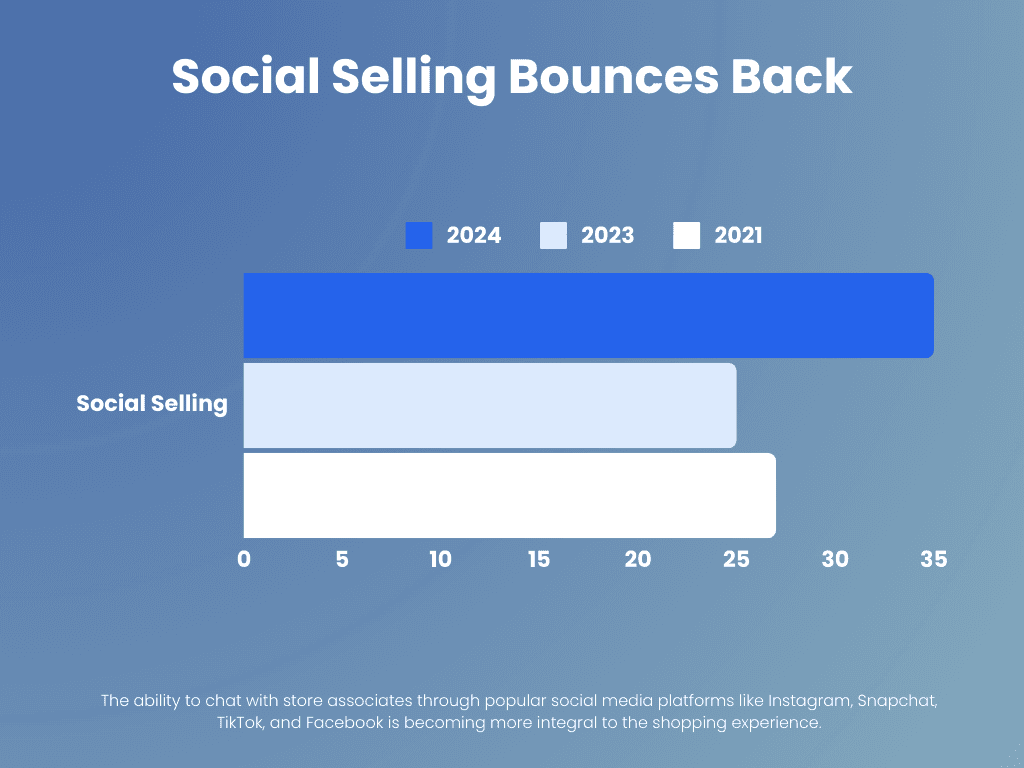
Additionally, the ability to chat with store associates through popular social media platforms like Instagram, Snapchat, TikTok, and Facebook is becoming more integral to the shopping experience. In 2024, 35% of consumers expected this capability, up from 27% in 2021, underscoring the increasing role of social media in facilitating consumer-retailer interactions.
These insights underscore a clear trend: as consumer expectations for convenience and personalized service continue to evolve, retailers must enhance their omnichannel capabilities to include effective clienteling and robust remote selling options to meet these emerging demands.
Personalized Shopping: The Surge in Tailored Experiences
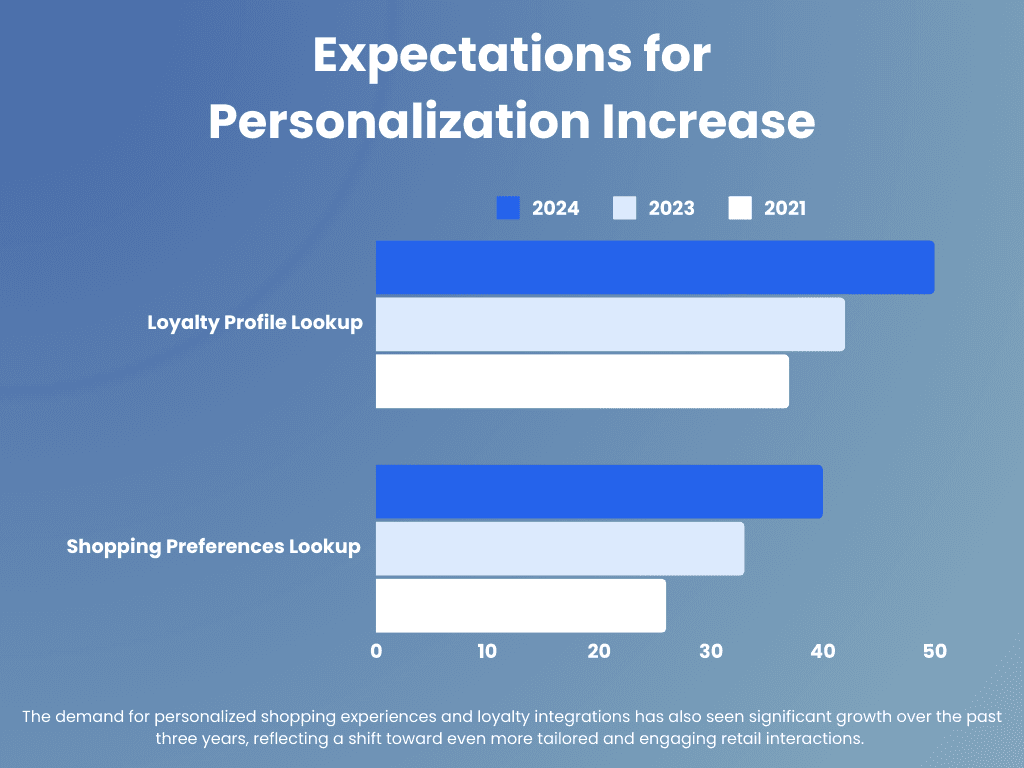
The demand for personalized shopping experiences and loyalty integrations has also seen significant growth over the past three years, reflecting a shift toward even more tailored and engaging retail interactions. The results of the 2024 NewStore survey underscore the rising importance consumers place on omnichannel capabilities that cater directly to their individual preferences and histories.
In 2024, half of the consumers expected store associates to be able to access their loyalty profiles and apply rewards just by knowing their names. This represents a notable rise from 42% in 2023 and 37% in 2021, highlighting an increasing preference for seamless and personalized loyalty interactions within the store environment.
Moreover, associates’ ability to retrieve complete shopping histories and preferences with just the customer’s name has climbed to 40%, up from 33% in 2023 and 26% in 2021. This trend indicates a growing desire for a highly personalized shopping experience that leverages data to make each interaction feel unique and tailored.
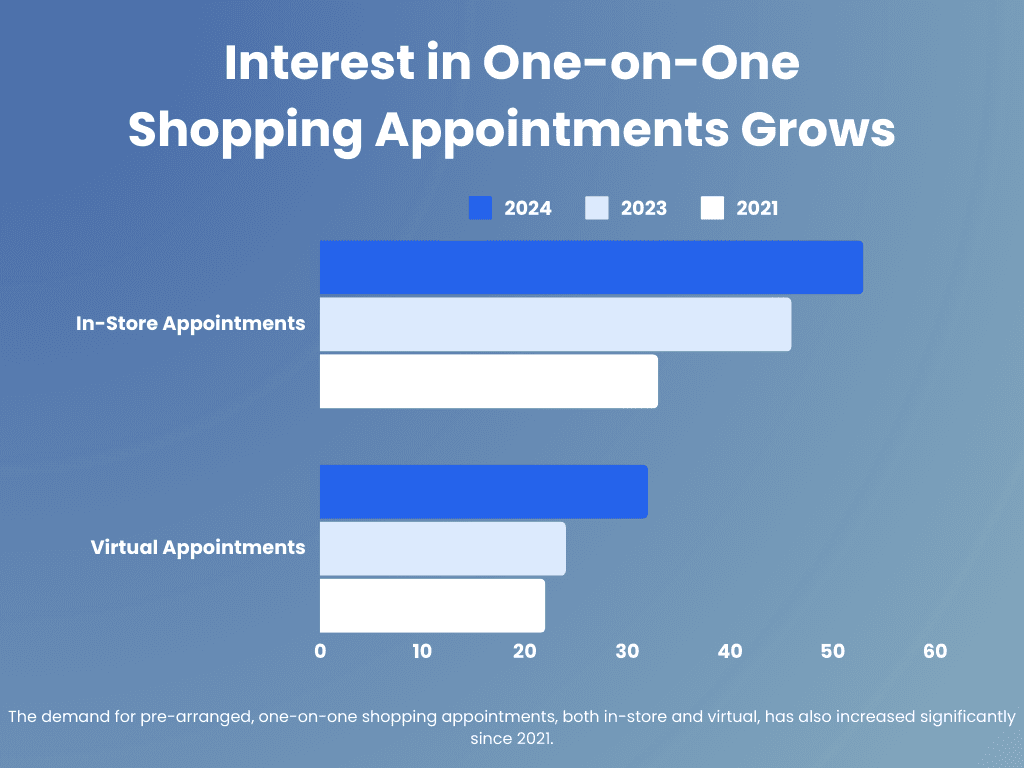
Additionally, the demand for pre-arranged, one-on-one shopping appointments in-store has also increased significantly. This year, 53% of consumers expected this service, up from 46% in 2023 and 33% in 2021. Virtual interactions have also gained traction, with 32% of consumers in 2024 expecting the ability to engage with store associates through video chat for personalized appointments, a rise from 24% in 2023 and 22% in 2021. This growth signifies an evolving retail landscape where digital and physical experiences converge to meet consumer needs.
A new dimension to this year’s survey is the expectation for personalized discounts based on previous purchases, with a substantial 66% of consumers valuing this proactive approach to discounting. This expectation demonstrates the potential for data-driven offers to enhance customer loyalty and satisfaction.
These insights reveal a clear trajectory toward more connected and personalized retail experiences. As consumer expectations continue to evolve, retailers must enhance their omnichannel capabilities to deliver not just products but also personalized and rewarding shopping journeys.
Mobile-Enabled Service: Keeping Pace with Consumer Expectations
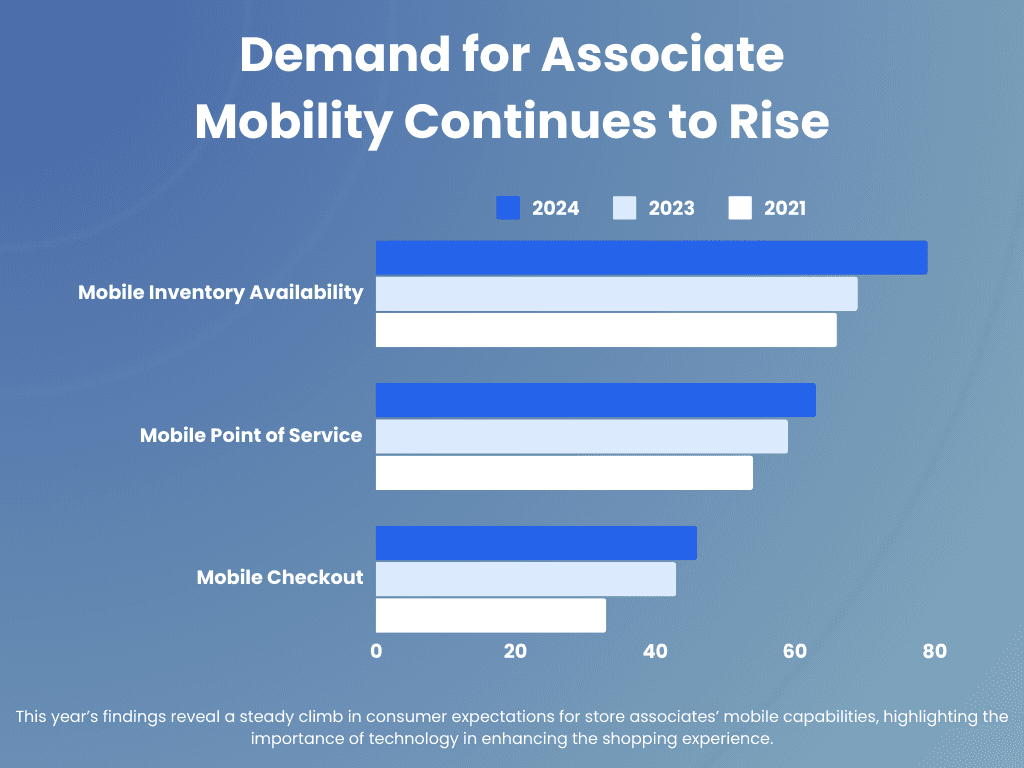
This year’s findings reveal a steady climb in consumer expectations for store associates’ mobile capabilities, highlighting the importance of technology in enhancing the shopping experience.
In 2024, an increasing majority of consumers (63%) now believe store employees should be equipped with mobile devices, continuing the upward trend from 59% in 2023 and 54% in 2021. This sustained growth underscores the necessity for retailers to adapt and equip their teams with the tools needed for real-time engagement and service.
Mobile checkout capabilities have also seen progressive growth. From 2021 to 2023, the demand for mobile checkout spiked from 33% to 43%. Over the last year, this figure has edged up to 46%, indicating a solidifying expectation among consumers.
The capability that continues to be most sought after is the ability for associates to check inventory directly from a mobile device without leaving the customer’s side. A significant 71% of consumers expected this service in 2024, marking an increase from 69% in 2023 and 66% in 2021. This feature not only enhances customer satisfaction but also streamlines the shopping process, emphasizing the value of integrated omnichannel solutions.
Lastly, a notable new stat in 2024 is the expectation for a “Runner” service. 69% of consumers think a store associate should be able to request items from the stockroom with a mobile device without leaving their side. This highlights the growing importance of maintaining a seamless shopping experience without interrupting customer interactions.
These trends reveal a clear message: consumers increasingly value—and expect—seamless and efficient interactions enabled by mobile devices in their shopping experiences. As these expectations continue to grow, it becomes imperative for retailers to invest in and prioritize mobile capabilities to meet and exceed customer demands.
Enhancing Convenience: Embracing Endless Aisle and Mixed Cart Capabilities
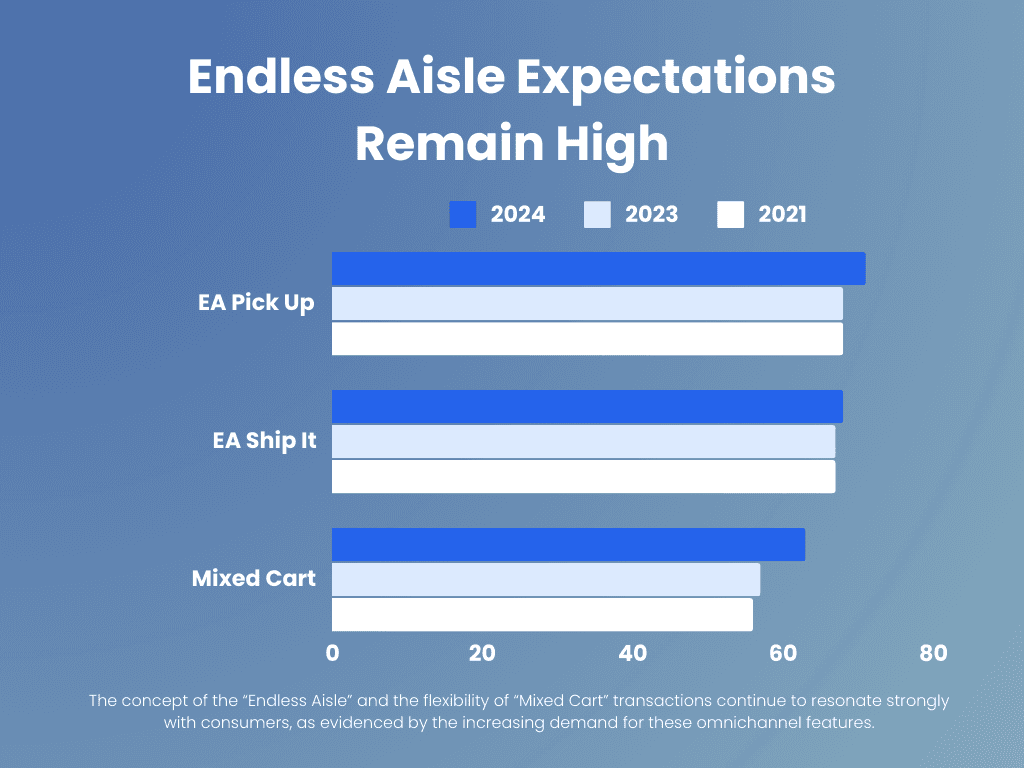
The concept of the “Endless Aisle” and the flexibility of “Mixed Cart” transactions continue to resonate strongly with consumers, as evidenced by the increasing demand for these omnichannel features. These capabilities, which extend the range of available products beyond what is physically present in-store, reflect a growing consumer expectation for convenience and seamless shopping experiences.
Endless Aisle, or the ability of store associates to sell products not available in the physical store, has maintained a high level of consumer interest. In 2024, 68% of consumers expected this capability, a slight increase from 67% in previous years. This steady demand highlights the importance of integrating logistics and inventory systems to provide a broader range of products to customers directly from the sales floor.
Similarly, the expectation that associates can facilitate Endless Aisle purchases where the consumer can pick up the item from another location has seen a more noticeable increase. In 2024, 71% of consumers expected this capability, up from 68% in 2023 and 2021. This uptick suggests a consumer preference for flexible shopping options that allow them to access and receive products in ways that best suit their convenience.
Additionally, the demand for Mixed Cart transactions, where items available in-store and those that are not can be purchased in a single transaction, has grown significantly. In 2024, 63% of consumers expected this capability, a notable increase from 57% in 2023 and 56% in 2021. This trend underscores the need for retailers to adopt POS systems and backend technologies that can handle complex transactions smoothly and efficiently.
These trends indicate a consumer desire for more comprehensive and convenient shopping experiences. As consumer expectations evolve, retailers must adapt by equipping associates with access to real-time inventory information and the necessary tools to sell and ship those products, regardless of where they are located.
Advancing Retail Technology: Self-Checkout and Digital Payment Preferences
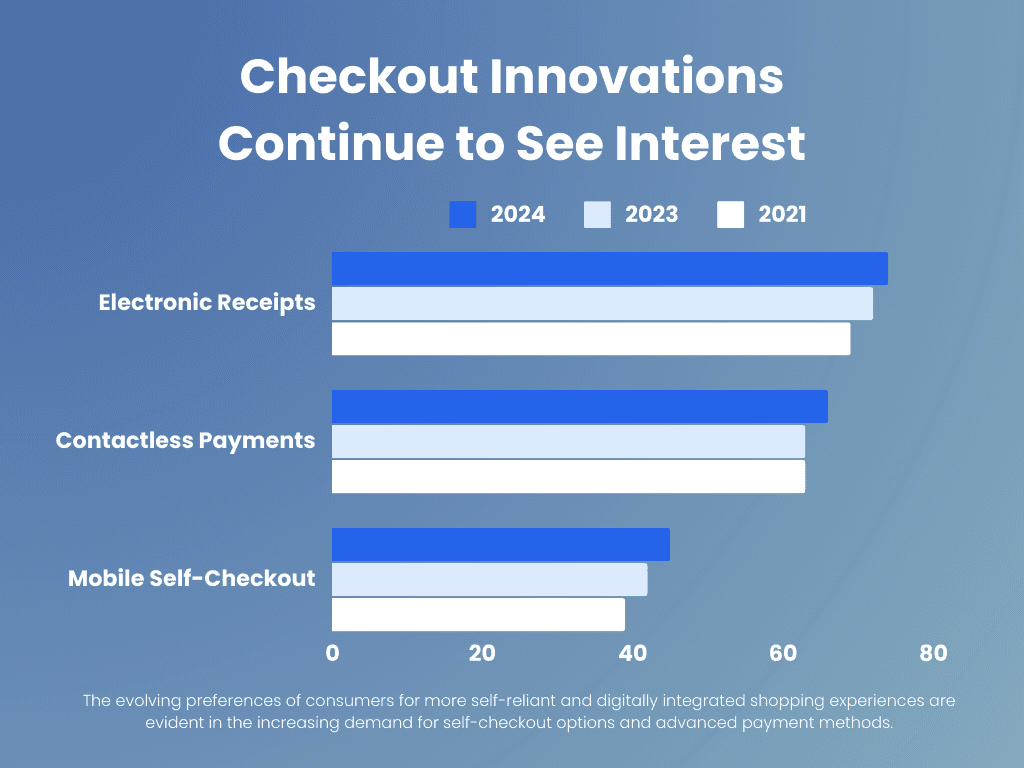
The evolving preferences of consumers for more self-reliant and digitally integrated shopping experiences are evident in the increasing demand for self-checkout options and advanced payment methods. These trends reflect a broader shift toward convenience and efficiency in the retail sector.
The desire for self-checkout capabilities, where consumers can complete their purchases using their mobile devices without needing to interact with a store associate, has seen a steady rise. In 2024, 45% of consumers expressed a preference for this feature, up from 42% in 2023 and 39% in 2021. This increasing demand highlights a growing consumer inclination towards autonomy and speed in their shopping journeys, suggesting that retailers should continue to enhance and streamline their mobile shopping technologies.
In terms of payment flexibility, the expectation that store associates accept all forms of contactless payment, including options like Apple Pay, Google Pay, Venmo, and PayPal, continues to grow. In 2024, 66% of consumers expected this capability, a slight increase from 63% in 2023 and 2021. This trend underscores the importance of accommodating diverse payment preferences, which not only simplifies the transaction process but also enhances the customer experience by offering more convenience and security.
Furthermore, the demand for electronic receipts—sent via email or text—is also on the rise. In 2024, 74% of consumers expected this service, up from 72% in 2023 and 69% in 2021. The increasing preference for digital receipts reflects a wider consumer demand for paperless and environmentally friendly options that also provide easier tracking and management of purchases.
These insights into consumer expectations illustrate a clear direction toward more technologically integrated and user-centric retail environments. Retailers must adapt to these evolving demands by implementing more robust digital solutions that cater to the convenience and efficiency consumers seek in their shopping experiences.
Conclusion: Meeting the Rising Expectations
This year’s survey highlights a clear and ongoing trend: consumers are increasingly demanding more from retail store associates, particularly in terms of omnichannel capabilities and personalized experiences. The rising expectations across various categories underscore the necessity for retailers to continuously adapt and enhance their service offerings.
Investing in mobile technology, enhancing personalized shopping experiences, and integrating seamless omnichannel capabilities are no longer optional but essential for meeting consumer demands. By staying ahead of these trends and understanding their customers’ evolving preferences, retailers can ensure they provide exceptional shopping experiences that drive loyalty and satisfaction.
Reach out to one of our experts if you’d like to learn more about how store associates can drive omnichannel success.
Mobile POS vs. Traditional POS System: What’s Really Different?
A traditional POS system and a mobile POS system can both process a transaction. The difference is what each one allows the store to do around it. Traditiona…
Jul 28, 2026
Five Signs You’ve Outgrown Your Legacy POS
Legacy POS systems don’t usually announce that they’ve reached their limits. Instead, they ask for one more workaround. One more integration. One more manual…
Jul 14, 2026
How to Build a Retail Clienteling Program That Drives Store Revenue
Clienteling is often treated as a relationship tool, but the strongest programs do more than keep customers engaged. They create a consistent way for store t…
Jul 9, 2026