How to Increase Store Sales with Retail Clienteling

Last updated on April 2nd, 2026 at 10:44 am
Incremental store revenue is rarely a demand problem. The customers are there. The relationships exist. The buying signals are present in every store visit.
What most retailers are missing is a structured way to act on them.
When retail clienteling is treated as a core part of store operations rather than a secondary engagement tactic, it gives associates a practical way to turn customer context into follow-up, follow-up into conversion, and conversion into repeat revenue over time.
Where Retailers Are Losing Store Revenue And Don’t Realize It
Retailers do not always lose revenue because customer demand is weak. Often, they lose it because high-intent moments are not captured after the initial store visit.
An associate may know exactly what a customer was looking for, what they almost bought, or what category they shop season after season. But if that knowledge is not easy to act on later, it disappears the moment the interaction ends. The potential sale becomes dependent on whether the customer comes back on their own or engages with a generic campaign later.
For store leaders, that is not just a missed relationship opportunity. It is missed revenue, and it is happening in stores that already have the customer relationships they need to grow.
Clienteling Strategies Work Best as an Operating Model, Not a Tactic
The strongest clienteling programs are not built around one-off outreach. They are built around a set of repeatable revenue-driving behaviors that can be embedded into the daily associate workflow.
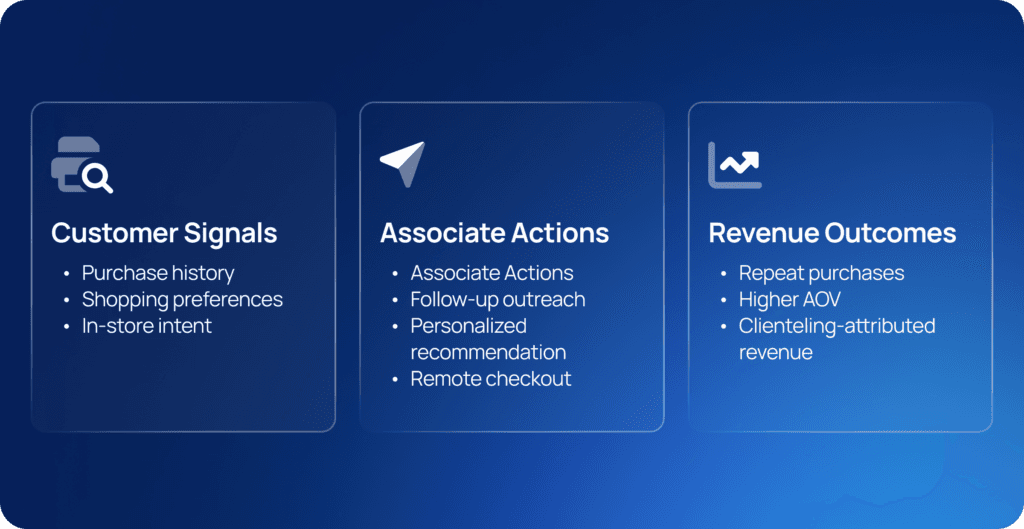
Recover missed in-store conversions
Not every store visit ends in a purchase, but that does not mean the sale is gone for good. A customer may need more time to decide, want to compare options, wait for a preferred size to become available, or leave before completing the purchase. These are not cold leads. They are qualified buying moments that simply did not convert during the visit.
Clienteling tools give associates a way to follow up with purpose. Instead of relying on a general marketing email to re-engage the customer days or weeks later, the associate can reconnect with context: the products discussed, the preferences shared, or the item the customer wanted but could not buy at that moment. That kind of follow-up is not just more personal. It is more commercially effective because it is tied to existing intent.
Prioritize high-intent outreach
Better retail clienteling results usually come from contacting the right customers first, not more customers. Associates are most effective when they can prioritize outreach based on signals that indicate likelihood to buy: prior purchases in a category, known preferences, or previous interest in a product that is now back in stock. That focus makes outreach more efficient and more relevant to the customer receiving it. Associate time is limited. A clienteling program only becomes sustainable when it helps associates act with more precision, not just more effort.
Extend selling beyond store walls
In a traditional model, an associate’s ability to generate revenue is largely tied to who walks in during a shift. Modern clienteling changes that.
Through curated recommendations, direct outreach, and remote checkout, associates can maintain momentum after the customer leaves. Revenue is no longer confined to foot traffic. It can be generated through ongoing relationships, even when the customer is shopping from somewhere else. For retailers trying to increase store productivity without increasing labor, that is a meaningful shift.
Build a repeatable black book
The long-term value of clienteling is not in a single follow-up. It is in helping associates build repeatable customer relationships that drive spend over time.
When associates maintain visibility into customer history, understand individual preferences, and continue relevant outreach across future buying moments, one-time shoppers become repeat customers. Associates begin to develop something closer to a managed black book rather than a series of disconnected interactions. That is where retail clienteling starts to influence lifetime value, purchase frequency, and store-level revenue consistency.
Retail Clienteling Metrics Store Leaders Should Track
Many retailers still evaluate clienteling through activity: messages sent, profiles created, feature usage. Those indicators matter, but they do not show whether clienteling is driving revenue.
The store operations leaders who see the strongest results track commercial outcomes instead:
- Clienteling-attributed revenue as a share of total store sales
- Follow-up conversion rate by associate and store
- Average order value on clienteling-assisted transactions vs. walk-in
- Repeat purchase rate from contacted customers
- Remote checkout conversion
- Revenue generated by associate-initiated outreach
Once that visibility exists, clienteling becomes much easier to improve. Leaders can identify which stores are outperforming, which outreach patterns convert most effectively, and where coaching is needed. Without measurement, clienteling tends to remain a concept everyone supports in theory, but few teams can optimize in practice.
The commercial impact is already visible in the results. At UNTUCKit, clienteling transactions account for 11% of all store sales, with clienteling-assisted orders delivering a 14.5% higher average order value than standard store transactions. At Mackage, nearly 30% of store sales through clienteling-attributed orders, including remote and non-remote carts.
The value of measurement is not just better reporting. It is giving store leaders a clearer view of how clienteling contributes to revenue and where it deserves more operational focus.
The Operational Foundation That Makes Clienteling Work
Retailers do not usually struggle with clienteling due to a lack of customer data. They struggle because acting on that data takes too much effort.
When an associate has to move between systems to check purchase history, confirm inventory, send outreach, and complete a transaction, clienteling becomes inconsistent. Every extra step creates friction, and friction kills adoption, regardless of how sound the strategy is.
Retailers that get more from clienteling solve that friction first. They give associates a single workflow where customer context, POS, inventory, and order management are connected in one place. Clienteling becomes an extension of how associates already sell, not an additional task layered on top of it. That is what determines whether the opportunity in existing customer relationships is actually captured or left on the floor.
See how connected clienteling helps stores turn associate outreach into measurable revenue.
Mobile POS vs. Traditional POS System: What’s Really Different?
A traditional POS system and a mobile POS system can both process a transaction. The difference is what each one allows the store to do around it. Traditiona…
Jul 28, 2026
Five Signs You’ve Outgrown Your Legacy POS
Legacy POS systems don’t usually announce that they’ve reached their limits. Instead, they ask for one more workaround. One more integration. One more manual…
Jul 14, 2026
How to Build a Retail Clienteling Program That Drives Store Revenue
Clienteling is often treated as a relationship tool, but the strongest programs do more than keep customers engaged. They create a consistent way for store t…
Jul 9, 2026