Endless Aisle Live London 2026: How agentic commerce, AI, and unified commerce are reshaping retail
Retail is entering a new era.
As artificial intelligence accelerates, customer expectations evolve, and commerce becomes increasingly connected, retailers face a critical challenge: how do they embrace the opportunities of AI and agentic commerce without losing the human experiences that make their brands unique?
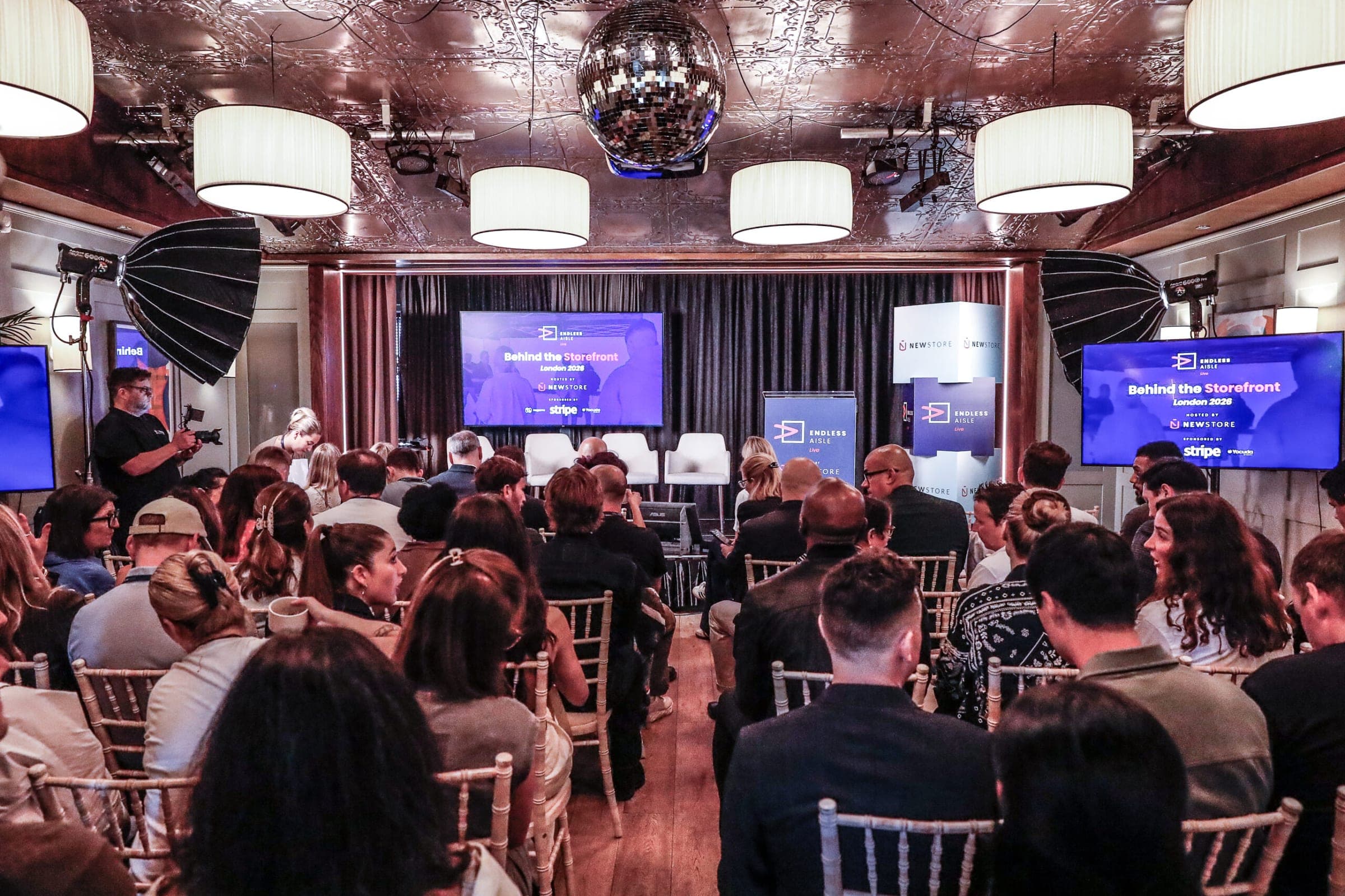
That question sat at the heart of Endless Aisle Live London 2026, NewStore’s flagship retail event, which brought together forward-thinking brands, technology innovators, and transformation leaders from brands including AllSaints, Boots, Dr. Martens, River Island, Kurt Geiger, Axel Arigato, White Stuff, and Represent.
Hosted in the heart of Soho, the event explored the future of retail through the lenses of agentic commerce, customer experience, store operations, and retail transformation. Through executive keynotes, store tours, expert panels, and peer-to-peer discussions, attendees examined how retailers can prepare for a future where AI increasingly influences how customers discover, evaluate, and purchase products.
Yet despite the focus on emerging technologies, the strongest conclusion from the day was surprisingly simple:
The future of retail may be powered by AI, but it will still be won through human connection.
Agentic commerce is coming faster than retail expects
Opening the event, NewStore CEO Mike DeSimone challenged attendees to think beyond today’s retail landscape and prepare for the next wave of transformation.
Agentic commerce – the concept of AI-powered agents acting on behalf of consumers to discover, compare, and purchase products – is rapidly moving from theory into reality. Consumers are already using large language models and AI assistants to research products, compare prices, and make buying decisions.
According to DeSimone, the real question is no longer whether agentic commerce will impact retail.
“The question isn’t if agents will shop for your customers. It’s when, and how we’re going to step up and be prepared for that.”
The challenge for retailers is that today’s AI systems excel at analyzing products but struggle to understand brands.
An AI agent can compare prices, specifications, and availability. What it cannot easily interpret is atmosphere, community, expertise, emotional connection, or the feeling of walking into a store that perfectly reflects a brand’s identity.
As DeSimone argued throughout the keynote, these are the elements that continue to differentiate retailers in an increasingly digital world.
“The store is where the brand experience gets delivered.”
For retailers investing heavily in AI, the message was clear: the goal is not to choose between agentic commerce and brand experience. The challenge is ensuring both can coexist.
From theory to reality: experiencing unified commerce in action
Rather than discussing retail transformation purely from a conference stage, Endless Aisle Live took attendees directly into the field.
Guests visited three leading retail destinations – AllSaints, Axel Arigato, and Kurt Geiger – where they experienced first-hand how retail technology is transforming customer journeys and store operations.
The tours provided a practical demonstration of how retailers are using mobile technology, clienteling, inventory visibility, and connected commerce capabilities to create frictionless shopping experiences.
What stood out most was how invisible the technology had become.
Barbara Menzel, former LVMH executive and founder of Alva Advisory, described Axel Arigato’s approach as:
“Completely frictionless shopping experience with no visible tills. The best retail tech is the kind you don’t notice.”
For many attendees, the tours reinforced an important principle of modern retail technology: customers do not visit stores to experience software. They visit stores to experience brands.
The most effective retail technology disappears into the background, enabling associates to focus entirely on serving customers.
Why store operations have become a competitive advantage
One of the most powerful themes to emerge throughout the day was the growing importance of operational excellence.
While customers rarely see the systems, workflows, and processes that support modern retail operations, they experience the results every time they interact with a brand.
During the “Behind and Beyond the Storefront” session, leaders from White Stuff, AllSaints, and Axel Arigato explored how operational performance directly impacts customer experience.
Steve Borg of White Stuff summarised the relationship perfectly:
“Marketing is the promise. It’s the operation that is actually delivering the experience.”
The discussion highlighted how inventory accuracy, fulfillment capabilities, mobile point-of-sale, store execution, and workforce enablement increasingly determine whether retailers can deliver on the promises made through marketing.
Sarah Langmead of AllSaints described inventory accuracy as one of the most important but least visible aspects of retail operations.
“The customer doesn’t feel any of that, but ultimately you get your product that you want.”
As retail becomes more connected and omnichannel fulfillment grows more complex, operational excellence is becoming one of the most important drivers of customer satisfaction.
How mobile technology is transforming the role of store associates
The role of the store associate is evolving rapidly.
Across multiple sessions, speakers emphasized that the greatest value of retail technology is not speed – it is time.
By eliminating manual processes and reducing operational friction, mobile-first retail platforms enable associates to spend more time doing what customers value most: building relationships.
Sarah Langmead explained how mobile point-of-sale technology has changed the way AllSaints teams interact with customers.
“It’s actually given us time.”
That time can then be reinvested into styling advice, product recommendations, clienteling, and deeper customer engagement.
Attendees repeatedly highlighted this benefit during feedback sessions.
Allegra, Store Director at JOSEPH, commented:
“I loved how easy and smooth the operations are with NewStore, especially having payments, clienteling, and the runner option on the same app.”
The consensus across the event was that the future store associate will be less focused on transactions and increasingly focused on creating memorable customer experiences.
Connected commerce is replacing channel thinking
Another major theme throughout Endless Aisle Live London 2026 was the evolution from omnichannel retail to connected commerce.
Retailers increasingly recognize that customers do not think in channels.
Customers move seamlessly between websites, stores, marketplaces, social platforms, messaging apps, and AI-powered search experiences. They expect retailers to do the same.
Represent’s Tim Robinson argued that physical retail has become more important, not less, as digital commerce expands.
“There’s a huge emotional gap that’s missing.”
Represent’s stores have been designed not simply as sales environments but as places where customers can engage with the brand, connect with the community, and build stronger emotional relationships.
That philosophy extends to how the business measures success.
“If you can make sure that every single person leaves feeling significantly better than when they came in, then you’ve done something really positive.”
This shift from transactional retail to experiential retail was a recurring theme throughout the day.
The future of retail transformation
The event’s final discussions focused on what retail transformation looks like over the next five years.
Leaders from Boots, River Island, and Dr. Martens explored the organizational and technological challenges of creating truly connected customer experiences.
Fabrice Khullar of Boots argued that retailers must stop allowing internal structures to dictate customer experiences.
“We’ve got to stop shipping our org charts through the products we build.”
Meriel Neighbour expanded on that vision, describing a future where commerce becomes entirely connected across every customer touchpoint.
“Shop what you want, when you want, how you want at any point in 24/7/365, and everything is seamless and frictionless.”
Achieving that vision will require retailers to rethink not only technology platforms but also organizational structures, data strategies, and operating models.
The future of retail transformation will be built on connected data, platforms, and experiences that seamlessly bridge digital and physical worlds.
The behavioral science behind better retail experiences
For the day’s headlines session, attendees were invited to explore how understanding customers has always been central to retail success.
Behavioral science expert Richard Shotton demonstrated how retailers can use psychology to improve customer experiences and influence purchasing decisions.
Drawing on decades of research, Shotton explored how music, pricing structures, environmental cues, and store design can subtly shape customer behavior.
His core message challenged traditional assumptions about consumer decision-making.
“People are cognitive misers.”
Rather than carefully evaluating every purchase, customers rely on shortcuts, emotional cues, and subconscious signals.
For retailers, this creates significant opportunities to design environments that improve both customer satisfaction and commercial performance.
Perhaps most importantly, Shotton reminded attendees that customers rarely remember every detail of a shopping experience.
“We are very selective in what we remember.”
The implication is that successful retailers must focus on creating memorable moments rather than simply efficient transactions.
What retail leaders learned from Endless Aisle Live London 2026
As attendees gathered for networking drinks overlooking Soho, conversations repeatedly returned to a common theme.
The future of retail is not a choice between technology and humanity.
It is about using technology to strengthen human connections.
Feedback from attendees consistently highlighted the quality of the store experiences, the expertise of associates, and the seamless integration of technology into daily operations.
Kasia Adamus of United Colors of Benetton called the experience:
“A great opportunity to network and exchange experiences, and share ideas with others. Overall, very inspiring.”
Perhaps the most fitting summary came from Jamie Irving of Pentland Brands:
“Brand experience is delivered as much through the salesperson as it is the fixtures and fittings.”
The future of retail still starts in the store
Endless Aisle Live London 2026 demonstrated that while AI, agentic commerce, and connected commerce will fundamentally reshape retail, they are not replacing the store.
Instead, they are increasing its importance.
The brands that succeed in the next era of retail will be those that combine intelligent technology, connected commerce platforms, and operational excellence with the emotional experiences that customers cannot get anywhere else.
As commerce becomes increasingly agentic, stores remain where brands become tangible, where trust is built, and where lasting customer relationships are formed.
For all the excitement surrounding AI and retail technology, that remains retail’s greatest competitive advantage.

Agentic Commerce is Reshaping Retail – But Can it Cross the Storefront?
Every conversation I’ve had about agentic commerce in the last six months has been an e-commerce conversation. The discussion is happening everywhere: at eve…
May 29, 2026
The “Next Now” of Retail: Lessons from NRF’s Big Show 2026
The lights were low, the bass was heavy, and the promo videos moved in cinematic slow motion. Standing on the…
Jan 20, 2026
Omnichannel Expectations Skyrocket: What Consumers Want from Store Associates
Each year, NewStore asks more than 1,000 consumers about the shopping experiences they expect modern store associates to provide. NewStore revisited the annu…
Jul 9, 2024